·7 min read·mythology
Dionysus at Sea: The Ship That Grew a Vineyard
Explore Homeric Hymn 7 through its shipboard wonders: failed bonds, a growing vine, transformed pirates and the helmsman who recognizes danger.
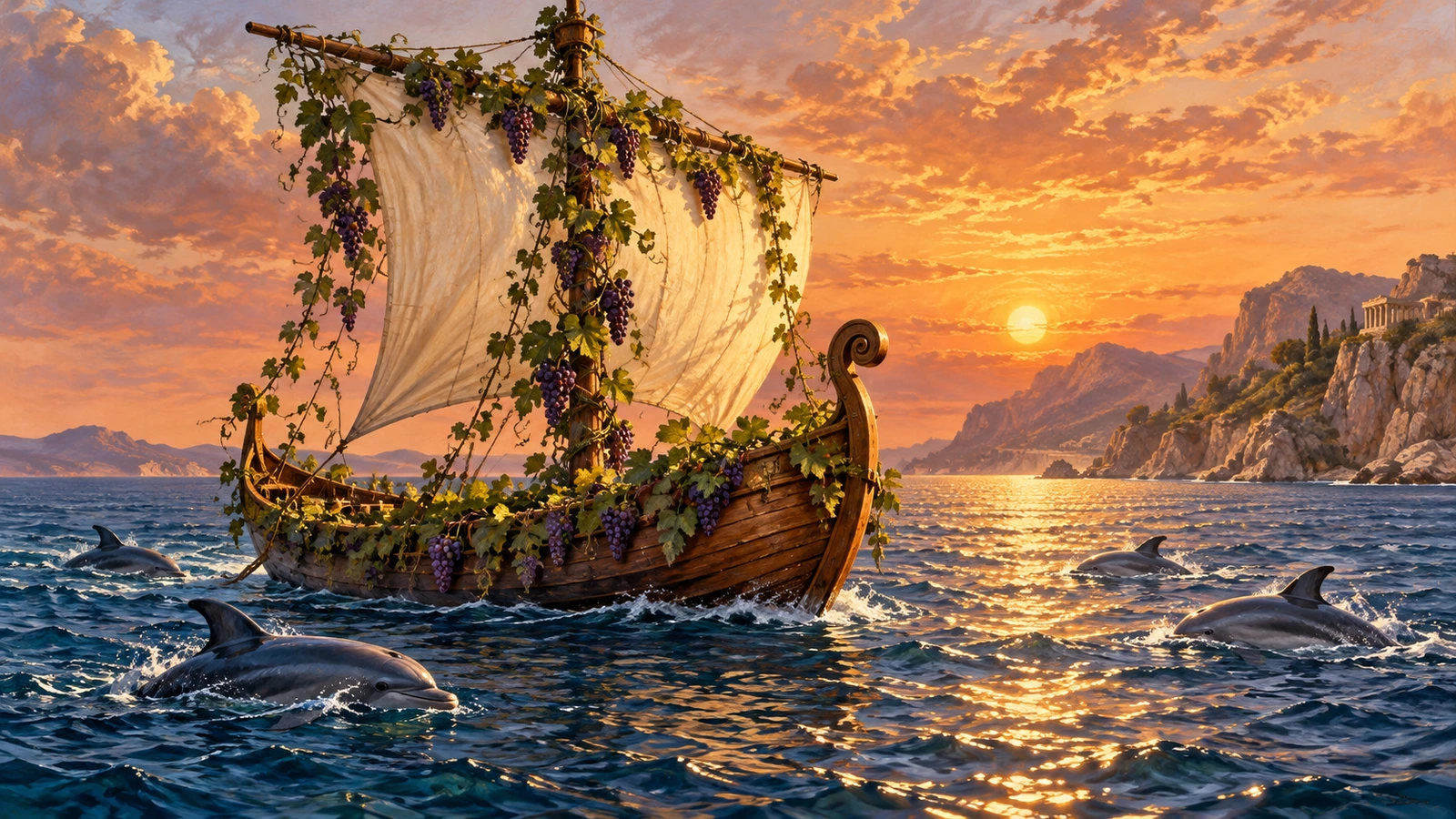
Imagine a ship under sail, far from the ordinary security of shore. The wind is filling its canvas when something begins to grow around the mast: ivy, then a grapevine heavy with clusters. A wooden vessel that should carry people across water becomes an impossible garden. This is one of the unforgettable images in the seventh Homeric Hymn, addressed to Dionysus. For the people aboard, however, the beauty brings little comfort. They have badly misjudged the passenger they recently took from the coast.
The short poem stages a recognition without needing an extended heroic journey. Seeing and understanding do not occur at the same moment. One person responds early to a warning sign; others continue to imagine profit. Rather than treating the poem as a summary of everything associated with Dionysus, this article follows its particular sequence. The primary text is H. G. Evelyn-White's public-domain translation of 1914. The Homeric designation places the hymn in a literary collection, rather than settling its individual authorship. [1]
A Person Seen as a Possible Cargo
The opening shows Dionysus on a headland, appearing as a young man with dark hair and a purple robe. Tyrsenian pirates notice him and take him aboard. They believe he is the son of wealthy rulers. The conflict begins with their interpretation of his appearance, not with a challenge that Dionysus issues to them. [1, lines 1–14]
Their assessment projects an imagined future. The stranger must have relatives, resources, and a value that can be extracted. The poem does not give them reliable information about those things. Clothing and appearance become the basis for a calculation. Someone seen as a person is rapidly treated as an object to be transported and exchanged.
That initial transfer of control will be reversed. The ship first appears to express the pirates' power: it can remove someone from the coast and carry him elsewhere. Later, the same vessel will not provide a space they can govern. The setting makes the error increasingly visible. What looked like a useful instrument of domination becomes the place in which their own expectations break down.
Bonds That Refuse to Hold
The pirates try to bind their captive, but the bonds fall away. Dionysus remains calm. The contrast supplies the first unmistakably unusual event. A coercive action has failed, while its intended victim shows no panic. The poem does not immediately turn this into a complete explanation. The crew must interpret what they have seen. [1, lines 7–24]
The helmsman takes the event seriously. He suggests that their passenger is a god and urges that he be released on shore. His proposed identities include Zeus, Apollo, and Poseidon. He has therefore recognized a category of danger without yet knowing the correct name. His important response is to accept that the event does not fit the crew's original assumptions.
The master rejects the warning and tells him to attend to the sail. Two understandings of responsibility now confront each other. For one, using the wind and continuing the voyage remain the immediate priorities. For the other, the passenger's unexplained nature makes continuing hazardous. A brief exchange makes the disagreement clear without a lengthy account of either man's inner life. [1, lines 15–31]
The Voyage Imagined as Profit
The master speculates about distant destinations and expects the captive eventually to reveal his family and wealth. Failed bonds are already before him, but he continues to plan an advantageous outcome. In the poem's structure, the new sign has not revised the old objective. The imagined payoff keeps the initial reading in place.
This does not establish a universal psychological law about greed or professional judgment. It does reveal how an expectation functions within a narrative. The helmsman reconsiders what he knows; the master tries to fit what he sees into a plan he already favors. The same occurrence moves two characters in different directions.
Their disagreement also changes the meaning of the spectacle that follows. Without the earlier warning, the wonders might be read simply as an abrupt surprise. With the warning, readers know that another course had been available. The crew's eventual fear is linked to an objection they could have heard sooner. Recognition becomes a question of timing as well as accuracy.
A Garden on Moving Water
Wine begins to flow through the ship, bringing a remarkable fragrance. A vine spreads along the sail, clusters hang from it, and ivy winds around the mast. Parts of the vessel become garlanded. The concealed divine identity emerges through images associated with Dionysus. A familiar separation between growing vegetation and a human-built object gives way to a different arrangement. [1, lines 32–42]
The scene joins movement with growth. A ship exists to travel; a vine wraps the place in which it grows. A sail should meet the wind; grape clusters turn it into a support for something entirely unexpected. The god's power is not represented merely as greater physical strength. It changes what the surrounding objects can be.
At last the pirates want to return to shore. Yet a late change of intention cannot restore the previous situation. Reversing one decision and reversing everything that has followed from it are different tasks. The poem now turns from fragrant abundance toward frightening animal forms. The same divine presence that produces the garden also removes the crew's remaining sense of security.
Those Who Leap and the One Who Stays
Dionysus takes the form of a lion, and the hymn also describes the appearance of a bear aboard. The terrified sailors leap into the sea and become dolphins. The helmsman is spared and kept aboard by the god. Their earlier difference in conduct becomes an explicit difference in outcome. [1, lines 43–57]
The dolphins are not evidence for the biological origin of a species. Within the poem's imagined world, transformation connects the initial mistake on shore with a new existence at sea. The vessel used to capture a stranger becomes the place where the captors lose the condition they thought secure. The narrative's reversal reaches its clearest form in that movement over the side.
Dionysus then names himself and encourages the helmsman. Exact identity becomes available only at the end. The helmsman had already acted appropriately without possessing it. This distinction keeps the episode from becoming merely a test of remembering divine names. Attention to an unexplained event mattered before complete knowledge was possible.
The ending also separates the protected sailor from the group without making him the hero of a conquest. His earlier action was verbal and practical: he advised release. The poem gives that response lasting importance. It allows a different outcome to arise from a different reading of the same encounter, rather than from superior weapons or a stronger claim to ownership.
What Can Be Concluded From the Text?
The vine, ineffective bonds, animal appearances, and dolphin transformation belong to an ancient literary account. They are not experimental evidence about natural events or the ancestry of marine mammals. The interpretation offered here concerns the order of the scenes and the contrasting responses of the characters. It supplies no generalized finding about real sailors or entire populations. Nor has the hymn been treated as the single definitive account of every Dionysian tradition. Its more limited contribution is clear and compelling: divine recognition develops through signs that people interpret differently. The ship's vineyard remains memorable partly because it brings that problem into a vivid physical setting. Remembering the image invites a further question about the narrative: why did those who first saw the same passenger fail to understand him in the same way?
Sources
- Homeric Hymn to Dionysus, Hymn 7, lines 1–59, in H. G. Evelyn-White's 1914 public-domain translation: Theoi Classical Texts Library. The narrative sequence was checked against the primary text; the explanatory prose is original.
Source access and editorial review: 13 October 2026. The AI-generated cover is an artistic scene inspired by the poem's vines and dolphins, not a precise reconstruction of a historical vessel.