·7 min read·mythology
Pandora's Jar: What Does It Mean for Hope to Stay Inside?
Read Pandora through Hesiod's Works and Days: the divine gift, the large jar, and two possible interpretations of hope remaining inside.
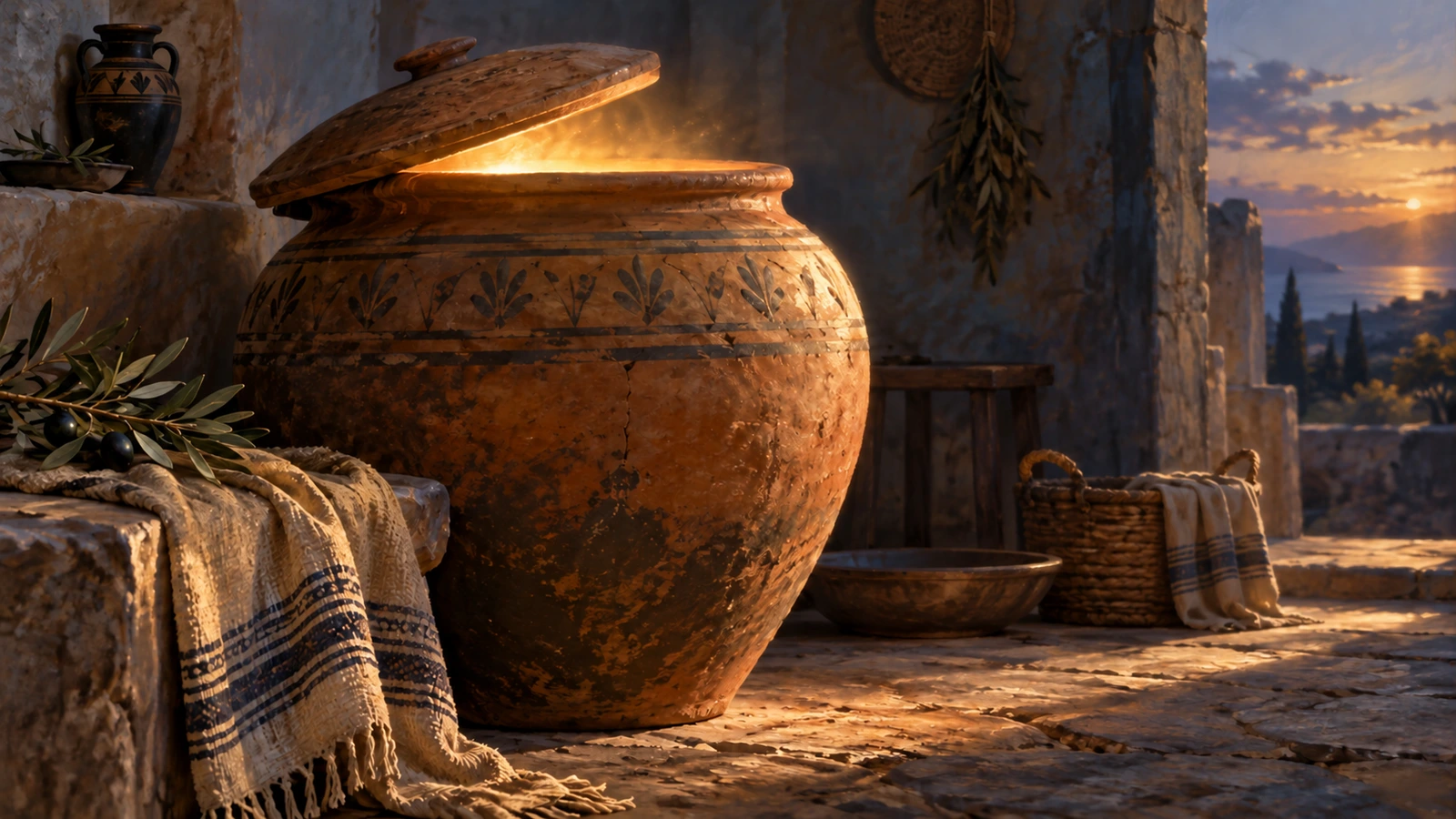
A closing lid usually signals that a story is over. In the account of Pandora, it introduces the hardest question: has hope been protected, or has it been kept beyond human reach? The familiar expression about opening Pandora's box suggests an action that releases unexpected trouble. Returning to Hesiod's Works and Days, however, reveals a different object and a less comfortable ending. There is a large jar. After afflictions escape, hope remains beneath its rim. That final placement makes a seemingly reassuring conclusion uncertain again.
Remembering Pandora only as a curious woman opening forbidden property can also obscure what precedes the scene. Hesiod places the episode within a dispute over fire, livelihood, divine authority, and the necessity of human work. Following the sequence reveals more than one person's action. The discussion here takes lines 42–105 as its primary evidence, using H. G. Evelyn-White's public-domain 1914 translation. It does not combine every later version into an account that the poem itself never gives. [1]
A Conflict Already in Motion
The passage begins with the gods withholding the means of livelihood. Hesiod imagines an alternative in which a day's effort could provide enough for a much longer period. The question of why human existence requires exhausting labor is therefore present before Pandora appears. Prometheus's deception of Zeus, the concealment of fire, and its recovery in a hollow fennel stalk belong to this larger argument. [1, lines 42–59]
Fire is more than a pleasing light in the narrative. It represents a capacity that changes human life. Yet the poem is not offering an evidence-based history of technological discovery. The advantage gained against divine intention is followed by a cost. Zeus plans a gift whose attractive appearance will conceal a harmful consequence. Something desirable to receive need not be beneficial to possess.
This beginning complicates the usual emphasis on Pandora's curiosity. She does not initiate the conflict. Her creation is part of a decision already made. The audience knows the intention behind the gift, while its recipient lacks that knowledge. The story's tension depends on that difference. It concerns the interpretation of appearances as well as the movement of a lid.
A Gift Made by Many Hands
On Zeus's instructions, Hephaestus mixes earth and water to create a human form. Athena supplies skills and clothing, Aphrodite contributes attraction, and other divine figures add adornment. Hermes supplies speech and deceptive qualities. The name Pandora is connected in the poem with the gifts contributed by the gods. She carries many endowments while also serving as the instrument of a punitive arrangement. [1, lines 60–82]
The account's generalizations about women reveal the perspective of its narrator. They should not be repeated as valid statements about women's nature. Understanding an ancient text does not require accepting its judgments. A more precise reading asks how the poem distributes responsibility and what narrative work it assigns to a female figure. That approach preserves the troubling features of the source without turning them into advice about living people.
The chain of creation also makes a single-person accusation inadequate. Different participants plan, shape, equip, and deliver the gift. If that chain disappears from a summary, the account becomes a woman's isolated mistake. Restoring it brings the prior decisions back into view. The visible action at the end of a sequence and the conditions that make it possible are related, but they are not identical.
An Understanding That Arrives Too Late
Prometheus warns Epimetheus against accepting a gift from Zeus. The warning is not followed. Recognition of the harm comes after acceptance, when the arrangement has already entered human life. The placement of that recognition gives the short episode its force. Information can be available without changing the decision that it was meant to inform. [1, lines 83–89]
This does not warrant a universal rule that every gift is dangerous. Hesiod describes a particular offering within a particular divine conflict. The audience's earlier knowledge makes the recipient's acceptance ominous. We see the gap between the warning and the action before the character experiences its consequences. By the time the danger is understood, understanding no longer prevents the initial outcome.
The poem does not spend long explaining the recipient's deliberation. Preparation occupies several stages; acceptance occupies a brief transition. That imbalance is itself effective storytelling. A carefully arranged consequence can enter the world through a gesture that appears simple. The ease of the gesture stands against the complexity of what the audience knows has been prepared behind it.
A Jar Rather Than a Little Chest
Pandora removes the great lid of the jar, and afflictions spread. The object need not be imagined as a small jewelry box. The large vessel conventionally identified as a pithos gives the scene a different material scale. The important distinction here is between the object described in this passage and the box familiar from a later idiom. This article does not attempt to establish the complete transmission history of that idiom. [1, lines 90–105]
Before the opening, the poem describes human beings as free from severe toil and sickness. Afterwards, diseases move silently through the world, having been deprived of speech by Zeus. That image gives form to harm arriving without an announcement. It is not a medical explanation. It is a mythic representation of an experience in which suffering can appear before people understand what is happening.
The jar therefore does more than contain a collection of things. It establishes a boundary between an interior and the world outside. Moving the lid changes that boundary. Most of the threatening contents are now beyond the container, but the narrative directs attention to what has not crossed it. Hope becomes the exception around which the ending must be read.
Two Ways of Reading What Remains
Elpis, rendered as Hope in Evelyn-White's translation, stays inside. Its location is explicit; its meaning for human beings is less straightforward. One possible reading treats the remaining interior as a protected place. Another treats the same interior as a place of confinement, with hope inaccessible to people who now endure afflictions. These are interpretations of the arrangement, not two additional events reported by the poem.
The uncertainty need not be considered a flaw. A narrative can keep working because its final image resists a tidy lesson. Being inside may mean being safe, or it may mean being unavailable. The same physical boundary supports different possibilities. Our understanding of the ending depends partly on whether we imagine the jar as a refuge or as a barrier.
Nor does identifying the word hope automatically establish a modern psychological claim. The poem gives a divine and symbolic account. It does not measure optimism, demonstrate the effects of expectation, or prescribe a strategy for coping with illness. Its language can prompt reflection, but reflection and experimental evidence serve different purposes. Maintaining that distinction allows readers to enjoy the image without asking it to prove what it cannot establish.
An Evidence-based Reading
The Pandora episode supplies no scientific explanation of disease and no evidence about the behavior of real women. What can be checked directly is the sequence in this particular source: divine preparation, acceptance of the gift, removal of the lid, and the retention of Elpis. Protection and deprivation are separate readings developed from the final placement. Keeping the source's statements distinct from our inferences makes a more substantial discussion possible. Instead of reducing the jar to a convenient moral, we can examine how an explanation begins, where responsibility is assigned, and why the last image remains unsettled. Pandora's jar then becomes a test of attention: how far back do we trace a consequence, and which unanswered question do we overlook when an ending looks reassuring?
Sources
- Hesiod, Works and Days, lines 42–105, in H. G. Evelyn-White's 1914 public-domain translation: Theoi Classical Texts Library. Narrative facts were checked against the primary literary source; the article uses independently written explanatory prose.
Source accessed on 13 October 2026. The cover is an AI-generated artistic interpretation, not a documentary photograph of an ancient artifact.