·7 min read·mythology
Persephone: The Pomegranate Seed That Joined Two Worlds
Explore Persephone's return through the Homeric Hymn to Demeter: the pomegranate, Eleusis, divine authority and a careful distinction between myth and evidence.
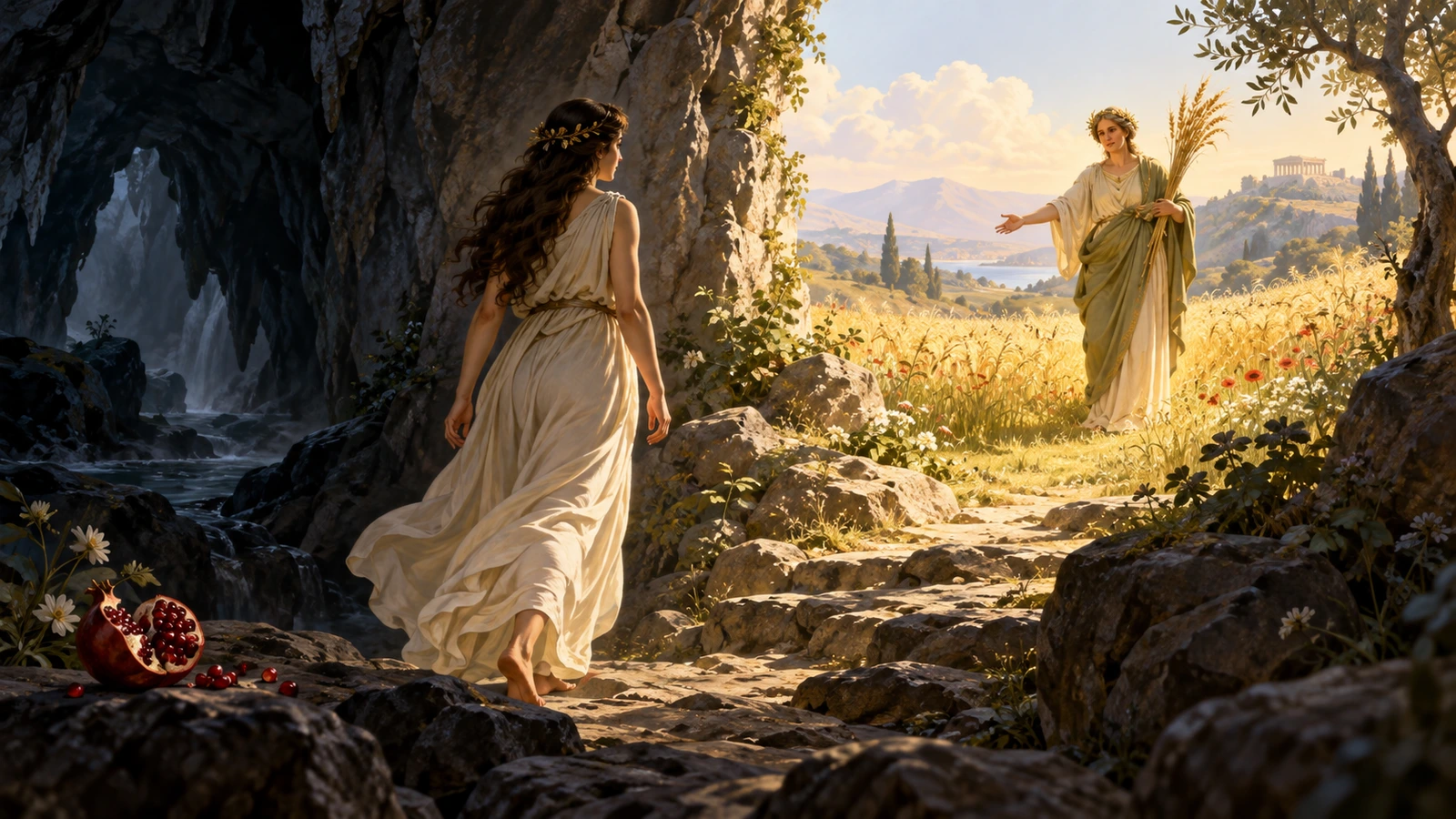
A pomegranate seed fits comfortably between two fingers. In the story of Persephone, something that small becomes a hinge on which the order of the world turns. A missing daughter, a searching mother, and fields that will not produce grain converge around a mouthful of food. The familiar explanation is that the myth tells us why seasons change. Yet the old poem raises more difficult questions: Who gets to decide the course of another person's life? What happens when the person who suffers a loss refuses consolation? Can a return restore everything that existed before?
Those questions are easier to explore when we follow one ancient version closely. Our guide here is the Homeric Hymn to Demeter, rather than a mixture of every story later told about Persephone. The word Homeric places the poem within a literary collection associated with the epic tradition; it does not establish that Homer personally wrote it. Treating the hymn as a particular source allows its unsettling details to remain visible. It also prevents a popular modern retelling from quietly replacing what the poem actually says. [1]
A Meadow With a Hidden Threshold
Persephone begins among flowers. The setting is rich with color and fragrance, and an extraordinary narcissus draws her attention. As she reaches toward it, the ground opens. Hades appears in his chariot and carries her below. The poem does not describe a willing departure. Persephone cries out, longs for her mother, and experiences the journey as something imposed upon her. That distinction matters whenever the story is presented as a straightforward romance. [1, lines 1–39]
Hades governs the realm of the dead, but describing him simply as a modern embodiment of evil also obscures the poem's setting. His position in the divine order and his conduct in this episode can be considered separately. Zeus, meanwhile, is not merely an observer who later helps solve a problem. The opening makes his authorization part of the arrangement. The conflict therefore concerns family authority as well as the boundary between the upper and lower worlds.
The scene works because a small, ordinary gesture leads into an immense change. Reaching for a flower should not alter a life. Here it exposes a decision that Persephone did not know had been made. Readers discover the consequences alongside her, while other divine figures already know more. That imbalance of information continues into the next stage, when Demeter must find out where her daughter has gone.
What the Witnesses Can Say
Demeter hears the cry but does not immediately learn its cause. She searches for nine days with burning torches. Her journey is also a search for reliable information. Hecate heard the voice without seeing the abduction. Helios can explain more. The poem distinguishes the witnesses instead of giving them identical knowledge. Their accounts help Demeter move from uncertainty toward an understanding of the arrangement behind the disappearance. [1, lines 40–89]
There is a recognizable problem here, even across the distance between ancient poetry and modern life. Something heard, something seen, and something reported by another person are different forms of knowledge. The hymn is not a statement of scientific method. Still, its arrangement of witnesses encourages careful reading: we can ask who knows each detail, how they know it, and when another character learns it.
Demeter's response also changes once Zeus's role becomes clear. Her grief develops into estrangement from the divine community. The poem does not assume that every participant finds the same arrangement acceptable. A private loss becomes a conflict within the structure of divine authority. The answer cannot simply be a comforting message. The relationships that made the original decision possible must also be addressed.
The House at Eleusis
Disguised as an older woman, Demeter reaches Eleusis and sits near a well. She is eventually welcomed into the household of Celeus, where she cares for Metaneira's young son, Demophoon. Short summaries often hurry past this episode to reach the reunion. The hymn gives it substantial space. Another household and another child become the setting in which the goddess's experience of separation takes a new form. [1, lines 90–274]
Demeter attempts to make Demophoon immortal. Metaneira sees the nighttime procedure, fears for her son, and interrupts it. The episode should not be treated as a practical instruction for childcare. Within the poem's imagined world, it exposes a gap between divine intention and human understanding. Metaneira believes she is protecting her child. Demeter believes a gift beyond ordinary human possibility has been misunderstood.
The two mothers do not occupy the same position, but the scene invites us to notice their different experiences of vulnerability. Demeter has lost access to her daughter; Metaneira fears losing her son. Their encounter does not resolve easily. The goddess reveals her identity and directs the people to build a temple. The story moves from a meadow to a household and then to a public sacred place. Eleusis becomes more than scenery: it connects the narrative to a particular landscape of worship.
When the Fields Fall Silent
Demeter withdraws into her temple and prevents the seeds from growing. Human beings face famine. The gods also face a threat because a devastated human population cannot continue to give them the honors and sacrifices described in the poem. Agricultural production and divine relationships belong to the same system. The daughter's absence now has consequences far beyond the family. [1, lines 301–333]
Zeus sends invitations and offers, but Demeter will not accept them. She insists on seeing Persephone before returning to Olympus or allowing the earth to bear crops. Her refusal changes what the other gods must do. Hermes is sent below, and an arrangement for Persephone's return follows. The story grants Demeter influence through the very function that makes her indispensable to human life.
It is tempting to turn this episode into a direct equivalent of a modern political dispute. Such a comparison can be suggestive, but it is an interpretation rather than evidence about a contemporary institution. The more immediate observation is that the poem links nourishment, authority, and kinship. An empty field and an empty household are two expressions of the same disruption. The world cannot resume its routine while the separation remains entirely unanswered.
Food and an Incomplete Return
Before Persephone leaves, Hades gives her pomegranate seed to eat. When she later tells Demeter what happened, she describes being made to taste it against her will. This is a significant complication for readings that treat the fruit as a freely chosen pledge of love. Different retellings can give the pomegranate different meanings, but the meaning in this article follows the wording and structure of the hymn. [1, lines 334–433]
The reunion itself is joyful. Mother and daughter run toward one another, and the poem pauses over their relief. But relief does not remove every condition attached to the return. Persephone will spend one third of the year below and the remaining two parts with her mother and the other gods. Readers familiar with a six-month division should resist transferring that detail into this particular account. Variations in the time allotted are reminders that Greek myth is not a single fixed handbook. [1, lines 441–469]
The emotional force of the conclusion lies in its qualified restoration. Persephone comes back, but a new pattern of time has been established. Separation becomes recurrent rather than disappearing. The story allows joy to coexist with a lasting change. That is one reason it remains powerful even for readers who do not approach it as a religious explanation of the world.
Evidence and Historical Perspective
The myth is not a scientific account of the physical cause of seasons. What historical study can examine is the poem's representation of divine relationships and the material evidence associated with worship. The Metropolitan Museum's record for fragments of the Great Eleusinian Relief connects Demeter and Persephone to the sanctuary and cult at Eleusis. An object can support that context without revealing every action performed in secret rites. [2] The narrative claims here come from the hymn; the limited discussion of material culture comes from the museum record. Observations about authority, loss, and return are interpretations developed from those sources, not measurements of universal human behavior. Keeping those distinctions clear makes the story richer: it lets ancient poetry speak with its own particular tensions while leaving room for thoughtful, explicitly identified modern readings.
Sources
- Homeric Hymn to Demeter, particularly lines 1–469, in H. G. Evelyn-White's 1914 public-domain translation: Theoi Classical Texts Library. The article uses original explanatory prose rather than direct quotations.
- The Metropolitan Museum of Art, Ten marble fragments of the Great Eleusinian Relief, consulted for the limited discussion of the sanctuary and cult context.
Sources accessed and editorial checks performed on 13 October 2026. The cover is an AI-generated artistic interpretation, not a documentary image of an ancient object or ceremony.