·5 min read·mythology
Where Is Noah’s Ark? Mount Ararat, Mount Judi, and the Mystery of the Great Flood
An ancient flood, a colossal vessel, and two mountains. What do the sources behind Noah’s Ark — Genesis, the Qur’an and Gilgamesh — actually say?
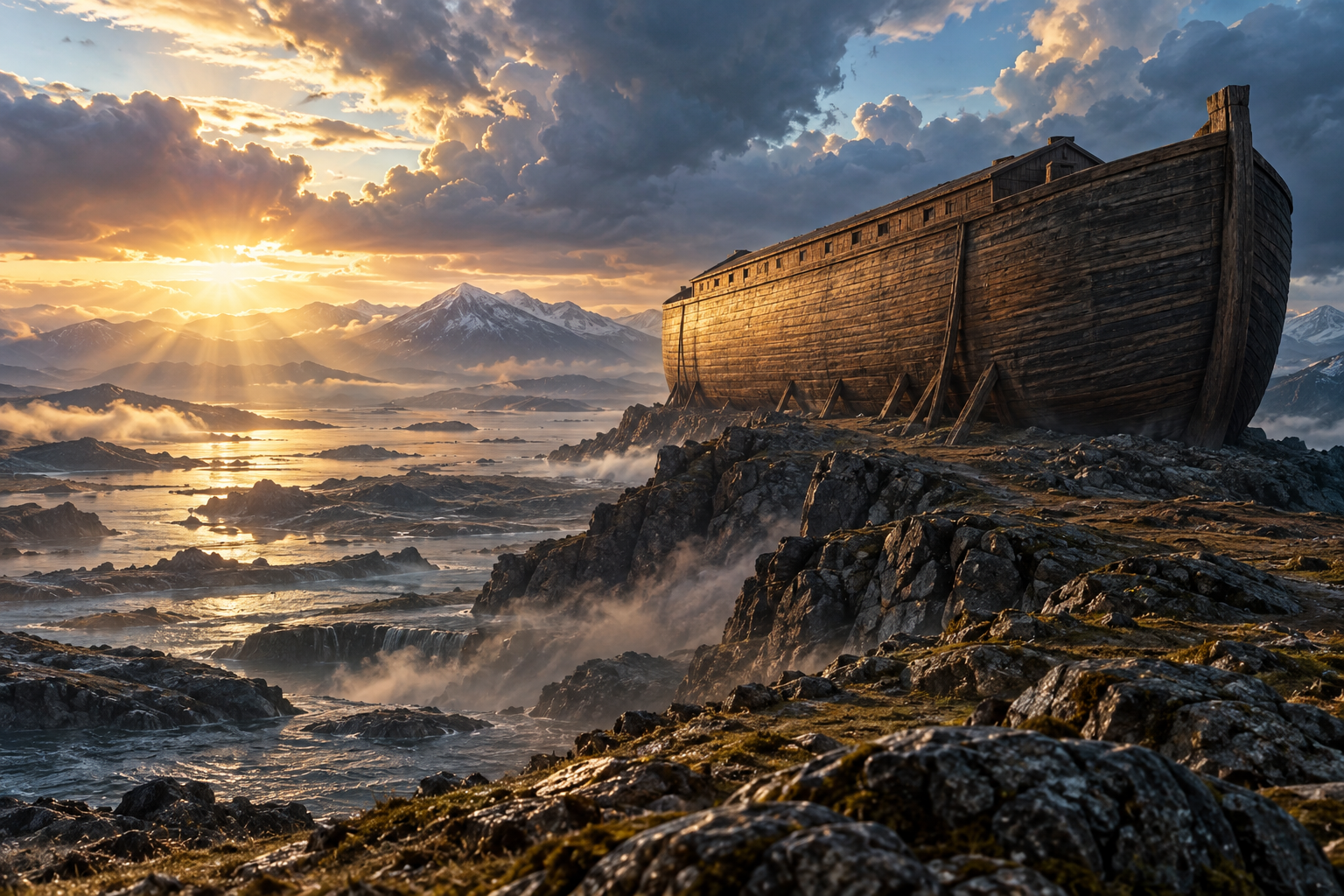
An ancient flood, a colossal vessel, and two mountains linked to one of humanity’s most enduring stories. Noah’s Ark continues to fascinate believers, historians, and archaeologists alike. But what do the ancient sources actually tell us?
The story of Noah’s Ark has survived for thousands of years, crossing religious, cultural, and geographical boundaries.
In the Jewish, Christian, and Islamic traditions, Noah is remembered as the man who survived a catastrophic flood aboard a vessel built under divine instruction.
Yet the story extends far beyond the Abrahamic religions. Ancient Mesopotamian texts contain strikingly similar accounts of devastating floods, specially constructed boats, and the survival of humanity.
Today, the search for Noah’s Ark is particularly associated with eastern Türkiye. Mount Ararat and Mount Judi both occupy important places in the story's geographical traditions.
But did the Ark actually exist? And if it did, where might it have come to rest?
Noah’s Ark in Sacred Texts
The biblical flood narrative appears in Genesis, chapters 6–9.
According to the account, God observes humanity’s growing wickedness and decides to bring a destructive flood upon the world. Noah, described as righteous, is instructed to build a great ark capable of protecting his family and preserving animal life.
After the floodwaters eventually recede, the Ark reaches land. The story concludes with a covenant between God and Noah, symbolized by a rainbow.
The Qur'an also tells the story of Noah, known in Islamic tradition as Prophet Nuh.
Its narrative emphasizes Noah’s mission to warn his people, their rejection of his message, and the rescue of those who believed. In Surah Hud, the account also describes Noah’s son refusing to board the vessel.
Although the biblical and Qur'anic versions differ in several details, they share central themes of responsibility, divine judgment, survival, and renewal.
Mount Ararat or Mount Judi?
One of the most intriguing questions concerns the Ark's final resting place.
Genesis 8:4 states that the vessel came to rest upon the “mountains of Ararat.”
The wording matters.
The original reference does not necessarily identify the particular mountain now known as Mount Ararat, Türkiye’s highest peak. Instead, Ararat was historically associated with Urartu, an ancient kingdom and geographical region north of Mesopotamia.
Over time, Mount Ararat became the most recognizable location associated with the biblical Ark.
The Qur'an, however, offers a different geographical name.
Surah Hud 11:44 explicitly states that the vessel came to rest upon Al-Judi, traditionally identified with Mount Judi in the Şırnak region of southeastern Türkiye.
This association has a long history in Islamic tradition and also intersects with earlier regional Christian traditions.
The distinction is therefore more complex than a simple disagreement between two mountain names. It reflects changes in geographical terminology, religious interpretation, and the transmission of ancient traditions.
Before Noah: The Flood in the Epic of Gilgamesh
Some of the most fascinating evidence relating to the cultural history of the flood comes from Mesopotamia.
The Epic of Gilgamesh, one of humanity’s oldest surviving literary works, includes a flood narrative with remarkable similarities to the biblical story.
In Tablet XI, a figure named Utnapishtim describes how he survived a catastrophic flood after being warned to construct a vessel.
He preserves life aboard the boat and, when the flood subsides, releases birds to determine whether dry land has appeared.
These details bear an unmistakable resemblance to elements of Genesis.
Other Mesopotamian traditions, including the Atrahasis epic and earlier Sumerian accounts, also describe devastating floods and human survival.
The decipherment of ancient cuneiform tablets during the nineteenth century transformed scholarly understanding of the flood tradition.
These texts demonstrate that flood narratives existed in Mesopotamian literature before the surviving biblical texts took their final forms.
However, similarities between ancient stories do not establish that they independently document a single historical catastrophe.
They may reflect literary transmission, shared cultural memories, or responses to comparable natural disasters.
Has Noah’s Ark Been Discovered in Türkiye?
For generations, explorers have searched the mountainous landscapes of eastern Türkiye for traces of the Ark.
Among the most widely discussed locations is the Durupınar formation, near Doğubayazıt in Ağrı Province.
The site attracted attention in 1959 after Turkish officer İlhan Durupınar noticed its unusual outline in aerial photographs.
Viewed from above, the formation resembles the shape of a large boat.
Over the decades, claims have emerged concerning possible structural features, petrified wooden material, and evidence of human construction.
However, previous geological investigations have supported a natural explanation for the formation.
In 2026, a new research project conducted field investigations and collected samples for laboratory analysis, reviving discussion about the site's geological characteristics.
The investigations have attracted considerable attention, but their preliminary observations should not be confused with a confirmed archaeological discovery.
As of October 2026, no scientifically verified discovery has established that the Durupınar formation is Noah’s Ark.
A boat-shaped outline alone is not sufficient evidence. Such a claim would require reliable proof of construction, identifiable materials, and a convincing archaeological context.
Could a Great Flood Have Really Happened?
Ancient Mesopotamia developed around the Tigris and Euphrates rivers, where flooding could have devastating consequences for settlements and agricultural communities.
Archaeologists have identified flood deposits at several ancient Mesopotamian sites. These findings demonstrate that significant flooding occurred, although the deposits cannot be treated as proof of one universal flood.
Modern geology has not established evidence for a single, worldwide inundation corresponding directly to the complete traditional account.
Nevertheless, major regional floods could have influenced stories that were preserved and transformed across generations.
The possibility of a historical event underlying some flood traditions remains a subject of interpretation rather than a proven identification.
Conclusion: Why the Story Still Matters
The physical location of Noah’s Ark remains unknown, and no archaeological discovery has conclusively verified the vessel's existence.
Yet the story's significance extends beyond the search for wooden remains on a distant mountain.
Across different cultures, flood narratives explore humanity's vulnerability to nature, the consequences of human actions, and the possibility of beginning again after destruction.
Noah’s Ark continues to occupy a unique space between faith, ancient literature, cultural memory, and archaeological curiosity.
Perhaps the enduring mystery is not simply where the Ark might have landed, but why the story of a great flood has remained so powerful in the human imagination for thousands of years.